
HH The Aga Khan Warns Followers Against Overuse of Screens
اردوCHITRAL: His Highness Prince Rahim Al Husseini, the Aga Khan V, Imam of the Ismaili Muslims world over, has, in a message (farman) 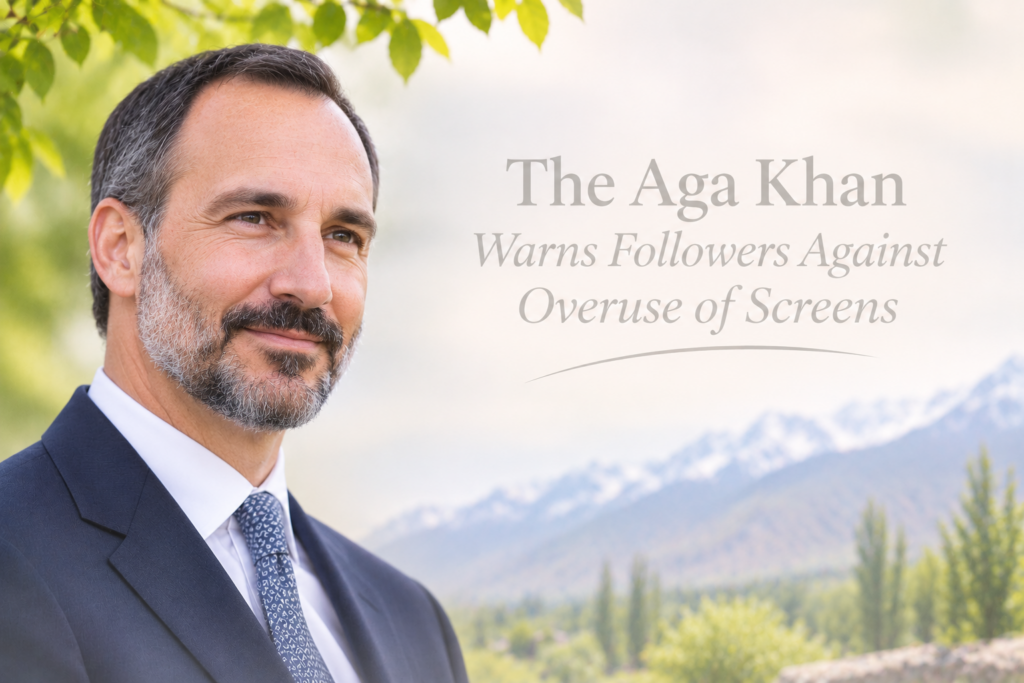 warned his followers against the potential ill-effects of overuse of the screen. A jist and analysis of his message is given below:-
We are living in an age when screens are no longer just devices. They have become habits, addictions and, gradually, an entire mental environment. We are no longer giving away just hours of our day to screens; we are surrendering our attention, our moments of silence and even our ability to think. Spending excessive time in front of screens is not simply a matter of tired eyes or disturbed sleep. It may also affect how our brains function and process information.
Social media is rewiring our brains, but not through any healing process. Rather, it is an ongoing experiment whose long-term consequences are not yet fully understood. Every notification gives us a sudden mental stimulus, every scroll interrupts a thought, and every new video creates another distraction. The human brain, which needs depth, continuity and silence to think clearly, is increasingly getting used to fragmented information. Our attention spans are shrinking, patience is becoming rare, and the ability to concentrate is gradually disappearing.
We may hesitate to accept it, but there is growing concern that smartphones are making us less intelligent in the way we process information. Having access to enormous amounts of information has not necessarily made us wiser. We know more things but understand less. We react quickly but rarely stop to reflect. Critical thinking requires questions, time and silence, but all three are becoming victims of the constant noise surrounding us.
It is easy to say that technology itself is not the problem; its misuse is. But this is only part of the truth. Social media platforms are designed to exploit human weaknesses, particularly our desire for attention, approval and instant satisfaction. It is not always we who control our phones; increasingly, our phones control us. Our habits, priorities and even the way we look at the world are gradually changing.
The real danger is not simply that we are reading less, but that we are thinking less. Deep thinking is being replaced by superficial understanding, questions by opinions, and knowledge by noise. If this trend continues, we may develop a generation of people who can react to almost everything but cannot sit quietly and think deeply about anything.
The real question is not whether smartphones are good or bad. The question is whether we still own our minds, or whether we have handed them over to glowing screens that keep us constantly occupied but not necessarily mentally awake.
Have we become masters of technology, or have we allowed technology to become the master of our minds? .. CN report, 01 Nov 2026