
Has Earth Already Exceeded Its Sustainable Population Limit?
A new scientific study has raised serious questions about whether the Earth can sustainably support its rapidly growing human population.
Researchers led by ecologist Corey Bradshaw of Flinders University, Australia, analysed more than 200 years of population and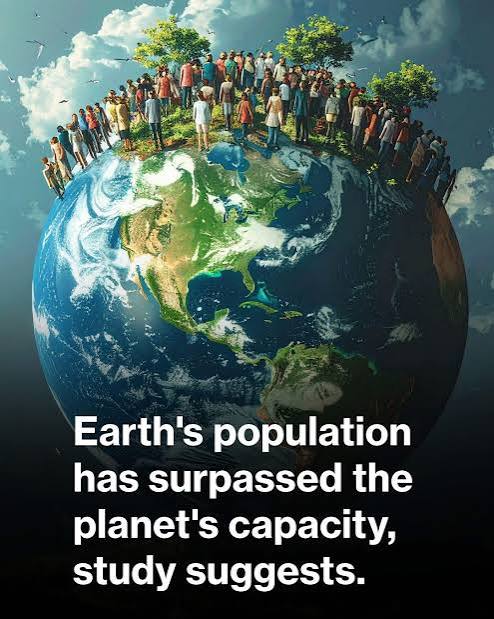 environmental data to estimate how many people the planet can support without permanently damaging its natural resources.
The study suggests that Earth’s theoretical maximum carrying capacity could be around 12 billion people. However, the number that could be supported sustainably under current consumption patterns may be closer to 2.5 billion.
With the world’s population now estimated at approximately 8.3 billion, researchers believe humanity is already living beyond sustainable limits.
Although population growth has slowed in recent decades, the total number of people continues to rise. Heavy dependence on fossil fuels and increasing consumption have also accelerated the use of natural resources.
The study warns that growing pressure on the environment is contributing to water shortages, loss of biodiversity, climate change and depletion of natural resources.
However, the researchers acknowledge that these figures are estimates based on scientific models and involve uncertainties. They also caution against using population concerns to justify discrimination.
The situation is not necessarily irreversible. Cleaner energy, responsible consumption, better resource management and fairer distribution of wealth could help reduce pressure on the planet.
The message is clear: Earth’s resources are not unlimited. The real challenge is not simply how many people live on this planet, but how wisely humanity uses its resources. .. Source