
Borrowing Dollars to Buy Cars: Pakistan’s Misplaced Economic Priorities
اردو.. by Dr Zafar Khan Safdar
Pakistan spent approximately $2.5 billion importing vehicles and car assembly kits in the financial year 2025–26. Interestingly, this was almost the same amount the country received from the International Monetary Fund (IMF) under its financial assistance programme. This 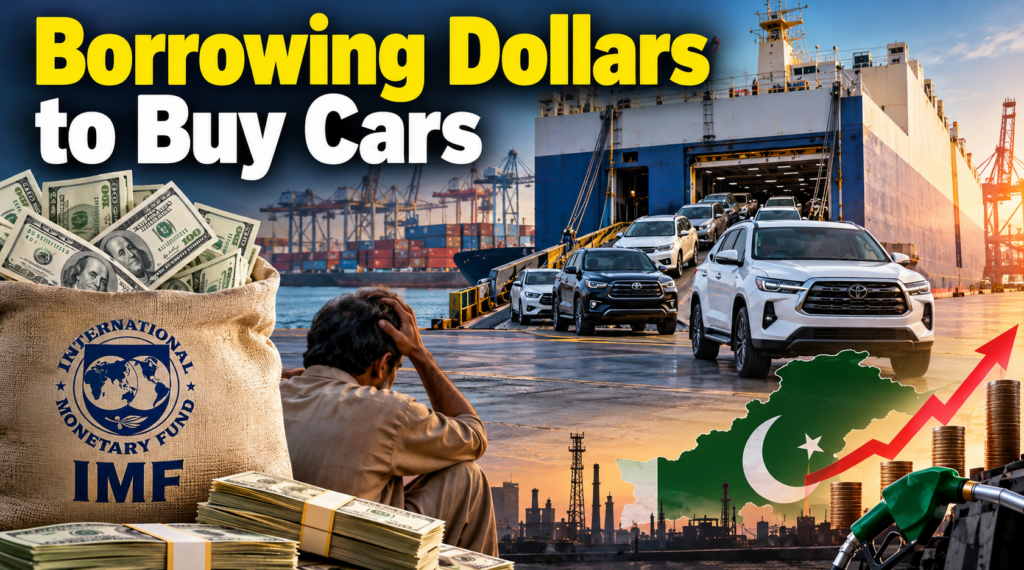 raises an important question: why is a country struggling with foreign debt spending billions of dollars on imported cars?
The problem is not simply the number of cars being imported. It is the structure of Pakistan’s automobile industry. Most local car manufacturers import parts and assembly kits, put them together in Pakistani factories, and sell the finished vehicles in the domestic market. As a result, the country spends valuable foreign exchange but earns very little from automobile exports.
According to the article, imports of car assembly kits increased sharply in 2025–26, while imports of fully built vehicles also rose considerably. Used car imports increased as well. This means that as consumer demand recovers, more dollars flow out of Pakistan instead of strengthening the country’s industrial base.
Pakistan’s automobile policies have attracted foreign investment and introduced new manufacturers, including Korean and Chinese companies. However, the industry has failed to achieve its export potential. Without genuine localisation, technology transfer and mandatory export targets, Pakistan risks remaining a market for foreign manufacturers rather than becoming a competitive automobile-producing nation.
Other countries offer useful lessons. South Korea transformed its automobile industry into a major global exporter. Malaysia developed its national car industry and later partnered with China’s Geely. India now earns billions of dollars annually from automobile exports. Pakistan, by comparison, continues to spend heavily on imported vehicles while earning little from exporting them.
The author also questions whether expensive electric vehicles are the right priority for Pakistan. The country needs to reduce its huge petroleum import bill, but affordable electric motorcycles and rickshaws could benefit ordinary citizens more directly than costly electric cars for wealthy buyers.
Pakistan needs an automobile policy that earns dollars instead of consuming them. The government should link incentives and market protection to export performance, increase local manufacturing, encourage technology transfer and promote affordable transport.
A country struggling with foreign debt cannot afford to treat foreign currency merely as money to spend. It must use it to build industries, create jobs and strengthen exports. .. Source