
Pakistan Needs an Austerity Emergency
اردو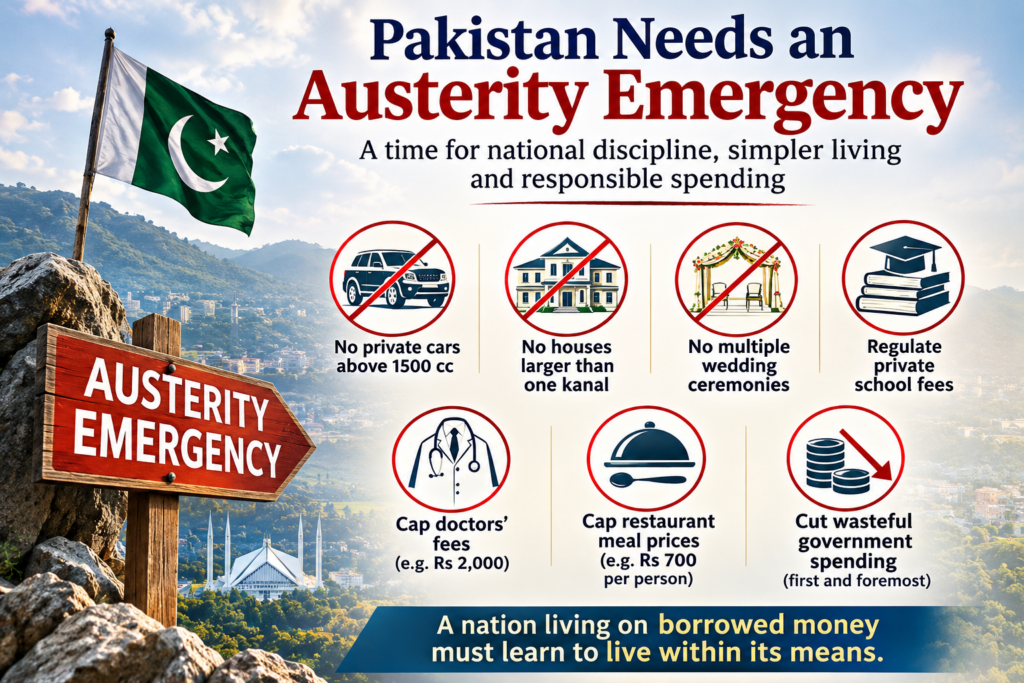 CHITRAL: Pakistan is passing through an economic crisis that needs no introduction. We are borrowing money to repay previous loans, borrowing again to meet daily expenses, and borrowing still more to keep the country running. Our exports are struggling, industries are under pressure, and there seems to be no convincing national plan for escaping this endless cycle of debt.
Increasing exports, promoting manufacturing and attracting investment are all necessary. But these are long-term solutions. They cannot rescue us overnight. There is, however, something we can do immediately: declare an Austerity Emergency and make it a national priority.
The idea is simple. As a nation struggling to survive, we must reconsider our definition of luxury and learn to live within our means. Some restrictions may be necessary, even if they are unpopular.
For instance:
- Restrict the purchase and use of private cars above 1500cc, with reasonable exemptions for essential commercial and utility vehicles.
- Discourage excessively large residential properties by restricting new residential construction beyond one kanal, while allowing families to own more than one reasonably sized property.
- Discourage multiple wedding functions and extravagant celebrations through enforceable limits on public expenditure and unnecessary displays of wealth.
- Regulate private school fees and discourage artificial distinctions between schools based merely on foreign affiliations and labels.
- Introduce reasonable caps on consultation fees charged by private doctors and specialists, perhaps initially at Rs 2,000, with appropriate provisions for exceptional cases.
- Set reasonable price limits on restaurant meals, perhaps Rs 700 per person for standard meals at high-end establishments, while allowing transparent exceptions for genuinely premium services.
These are only a few examples. A serious national austerity programme could identify dozens of other areas where unnecessary expenditure can be reduced.
Naturally, critics will argue that such measures interfere with individual freedom and the right to spend one’s money as one wishes. They would have a point. But is unrestricted personal choice more important than the economic survival of an entire nation?
When a patient is diagnosed with cancer, painful treatment may become unavoidable. Nobody welcomes the suffering, but the alternative may be far worse. A country in deep economic trouble must also be prepared to accept difficult treatment.
China’s transformation offers an interesting, though not entirely comparable, historical example. Under Mao Zedong, the country imposed extraordinary restrictions on individual lives, including the one-child policy introduced much later in 1979. That policy itself came with serious human consequences and should not be presented as a model to follow. But it illustrates how far governments have sometimes gone in pursuing national objectives.
Pakistan does not need to imitate China’s political system or violate fundamental human rights. It needs to learn the importance of national discipline, collective responsibility and long-term thinking.
The real question is this: If a nation cannot afford its present lifestyle, should it continue living beyond its means simply in the name of personal freedom?
We cannot keep borrowing to finance extravagance. We cannot demand sacrifice from ordinary citizens while the state, its institutions and the privileged sections of society continue to display excess.
An Austerity Emergency must begin at the top. Government expenditure, official privileges, luxury vehicles, foreign trips, oversized residences and unnecessary public spending must come under scrutiny first.
Pakistan may look reasonably normal on the surface, but beneath that surface its economic foundations are dangerously weak. We are a nation living on borrowed money and, increasingly, borrowed time.
Perhaps the time has come to choose between temporary discomfort and permanent decline. The change must come from the top. A nation that refuses to make sacrifices voluntarily may eventually be forced to make them by circumstances. .. CN report, 06 Nov 2026
An excellent and thought-provoking article. Pakistan desperately needs an austerity emergency but it must begin with our ruling elites. It is highly unjust to expect ordinary citizens to bear the burden of economic hardships while our political leadership and priviliged classes continue to enjoy extravagant life style, unnecessary perks and priviliges at public expense. The ruling elites must practice what they preach. No nation can overcome an economic crisis without sacrifice accountability and exemplary leadership from those at the top. You have highlited a much needed debate at a time when the country is going through a deep economic crisis.