.. by Shahzada Iftikhar Uddin
Since 2013, under successive PTI-led governments in Khyber Pakhtunkhwa (KP), the province’s forest resources have suffered alarming and unprecedented degradation. Independent observations and time-series analysis of satellite imagery, using open-source platforms such as Google Earth, indicate a consistent and widespread decline in forest cover across multiple regions of the province.
The long-standing destruction by the timber mafia has increased largely unchecked, critically undermining the ecological integrity and sustainability of KP’s forests. Rather than strengthening protection and enforcement mechanisms, several policy interventions introduced during this period have weakened forest governance and violated both the Khyber Pakhtunkhwa Forest Ordinance, 2002 and internationally accepted principles of sustainable forest management.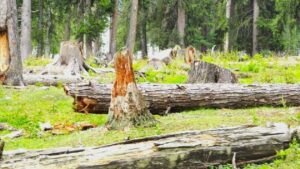
Policies introduced under various labels—including so-called woodlot initiatives, permissions for removal of dry and dead trees, and non-binding and flexible extraction rules in ecologically sensitive regions such as Kohistan and Chitral—have, in practice, facilitated large-scale commercial extraction, overriding legal limits rather than promoting conservation. These measures have collectively contributed to irreversible damage to local forests, accelerated biodiversity loss, and weakened the resilience of forest ecosystems already under stress from climate change.
Of particular concern is the reported proposal to de-notify approximately 650,000 acres of Guzara Forests in the Hazara Division, allegedly paving the way for their conversion into commercial housing projects. The Makniyal Forest stands out as a prominent example, where forestland is reportedly being designated for real estate development—threatening one of the region’s critical ecological buffers against floods, landslides, and water scarcity.
The Arandu Gol in Chitral, located next to the Afghan border, is yet another glaring example of the power of the ubiquitous timber mafia, where satellite imagery shows the area has lost 35% of its forest cover since the year 2000, revealing more than Rs. 100 billion worth of timber has been smuggled into Afghanistan. At his UN address, PM Shahbaz Sharif mentioned US$34 billion in flood damages in 2025 and declared a climate emergency, noting that the financial toll, according to estimates of the World Bank and IMF, of four flash floods in 2010, 2015, 2022, and 2025 mounted to US$91 billion, thereby wiping out nearly ten years of Pakistan’s GDP growth.
Pakistan’s Climate Crisis Worsens Amid Forest Department Incompetence And Timber Smuggling. Time has shown that, contrary to the remarkable conservation efforts of KP’s Wildlife Department, the conservation initiatives of the Forest Department are questionable, as the timber mafia gets its way in transfers and postings
In 2025, the UN extended US$1.5 billion to Pakistan to combat climate change, which has yet to materialise. The question is whether the UN’s climate initiative will help the Federal and Provincial Governments come up with leveraged interventions to save our forests and strengthen enforcement to control the voracious timber mafia. A peek into the money trail of bank accounts of timber dons of Swat and Chitral and their close circle, along with high-ranking officials involved, will reveal a murky and highly skewed nature of KP’s Timber Policy. The system operates in such a way that timber financiers based in Swat and Peshawar, along with their commission agents, end up pocketing the bulk of the timber proceeds at the cost of 95% of local communities.
Equally alarming is the growing disconnect between actions on the ground and the Environmental Emergency declared by the Prime Minister during the 2025 floods, which explicitly recognised deforestation as a key factor intensifying climate-induced disasters. Despite this declaration, massive forest clearing reportedly continues, including in border and mountainous areas that historically served as natural flood regulators, ecological shields, and climate buffers.
Credible assessments further suggest that nearly 27% of KP’s remaining natural forests are currently under threat, with fears that significant portions may be irreversibly converted into commercial and residential projects. Even the Margalla Hills—long considered a symbol of protected natural heritage—have reportedly suffered fragmentation and encroachment due to the unchecked expansion of housing societies.
These developments represent far more than environmental violations. They pose a direct threat to public safety, climate resilience, water security, and the livelihoods of forest-dependent communities. Forest degradation amplifies flood risks, accelerates soil erosion, disrupts hydrological cycles, and deepens poverty in already vulnerable regions—turning environmental mismanagement into a humanitarian and economic crisis.
Since the year 2000, Arandu Gol, next to the Afghan border in South Chitra,l has lost 35% of its forest cover, valued at over 100 billion rupees. Recent developments in Arandu Gol further expose the depth of governance failure surrounding forest management in KP. What is unfolding there is not an isolated incident but a revealing case study of how illegal timber extraction, weak enforcement, and local power asymmetries converge—leaving forests depleted and local communities economically trapped. The situation in Arandu Gol underscores how forest-dependent populations are being coerced into exploitative arrangements, while organised timber networks accumulate profits with impunity.
Given the scale, organisation, and persistence of illegal timber extraction, there is now a compelling need for direct intervention by the highest levels of the state. The financial stranglehold exercised by timber mafias has systematically exploited forest-dependent communities—from Arandu Gol to Kohistan and beyond—pushing them into a cycle of dependency, coercion, and long-term impoverishment, while powerful intermediaries reap windfall profits. Where administrative enforcement mechanisms have demonstrably failed or been compromised, extraordinary support to local authorities, in strict accordance with the Constitution and law, is justified and necessary to protect national ecological assets, safeguard vulnerable communities, and prevent future climate disasters.
Such intervention must prioritise confiscation of illegal timber stockpiles, disruption of illicit supply chains, protection of local communities and whistleblowers, and the restoration of forests as shared public goods rather than sources of private plunder.
Time has shown that, contrary to the remarkable conservation efforts of KP’s Wildlife Department, the conservation initiatives of the Forest Department are questionable, as the timber mafia gets its way in transfers and postings. A case in point is the enforced transfer of Secretary Forest Shahid Zaman, who stood up against the plans of the timber, mining, and real estate mafia’s encroachment into forests at Makniyal and Arandu Gol.
COP30 Climate Pledges Rely Heavily On Land-Based Carbon Removal, Overlook Forest Protection
The forests of Khyber Pakhtunkhwa are not expendable assets. They constitute the province’s first line of defence against climate extremes and ecological collapse
Soon after the Federal Government transferred the former KP Secretary Forests, the timber mafia accelerated to grind their axes in Makniyal and Arandu Gol. In the latter case, rupees 10 billion of illicit timber in possession of mafia dons is proposed to be transferred through the same mafia involved in the illegal felling of thousands-of-years-old forests. Simply put, conservation does not offer any incentives, while illegal felling of precious forests ensures heavy dividends. The new Forest Department directive reversed the former administration of the KP Forest Department’s directive of forceful seizure of illicit timber and penalising the well-connected criminals behind climate change disasters, thereby paving the way for the timber dons to “make hay while the sun shines.”
The Forest Department is presently in complete disarray, as an overwhelming majority of the local forest communities are running from pillar to post to realise, under the High Court directives, recoveries of their stolen royalty proceeds, stashed away in private bank accounts of the mafia dons. The handiwork of the pliant bureaucrats overseeing the execution of timber policies is in full display once again, since the timber business offers irresistible incentives to the elites and officials involved.
No wonder, lately, local commission agents of the timber financiers based in Swat and Peshawar converged to sign away fresh royalty purchase agreements with so-called tribal leaders. These influential elites have constructed many palatial houses in Chitral and Peshawar, and assets well beyond their means, while their fellow villagers in Arandu Gol experience the worst socio-economic indicators in the entire KP.
The governing authorities responsible for the plunder of KP’s precious resources conveniently ignore court orders to recover wrongful payments made to mafia dons, thereby leaving the poor local communities vulnerable to exploitation and desperately seeking justice in a system where outcomes so far have favoured those with connections rather than the rule of law.
The affected local forest communities have therefore demanded immediate intervention by COAS Gen Asim Munir, the Prime Minister, and the CM KP to crack down on the smuggling rackets responsible for the disappearance of 35% forest cover from Arandu Gol. The KP authorities have ignored PM directives issued in August 2025 for the seizure of an estimated Rs 10 billion worth of illicit timber at Arandu Gol, spending those proceeds on local economic development, thereby raising fears of a conflict in the forest communities. The Federal Government arbitrarily transferred the former KP Forest Secretary, who had previously clamped down on real estate, timber, and mining mafia’s encroachments within forestlands in Makniyal and Arandu Gol, reigniting the timber mafia, flexing its muscles to scuttle all pro-environment moves.
Likewise, contrary to what transpired in the actual proceedings of the meeting chaired by the CM KP on Makniyal and Arandu Gol Forests, the minutes issued conflicted with the decisions taken during the meeting, thus confirming the presence of the deeply embedded timber mafia inside the highest echelons of the KP government. Open manipulation of the minutes, chaired by the KP CM, points to an axis that runs deeper than what meets the eye. This poses a great challenge for environmentalists, conservationists, and policy makers alike, since the CM KP also holds the portfolio of Ministerof Forests.
The unchecked power of the timber mafia poses an existential threat to Pakistan, which is a top-ranking vulnerable nation according to the Global Climate Change Risk Index.
The forests of Khyber Pakhtunkhwa are not expendable assets. They constitute the province’s first line of defence against climate extremes and ecological collapse. Continued neglect—whether through policy failure or deliberate inaction risks pushing these ecosystems beyond the point of recovery, at an immense cost to present and future generations.
An immediate moratorium on forest de-notification and conversion of forestland for commercial development.
An independent, satellite-based audit of forest cover change in KP from 2014 to the present, conducted by credible national or international institutions.
Transparent accountability of KP officials and policy decisions that facilitated forest degradation in violation of existing laws.
Full alignment of provincial forest policies with the KP Forest Ordinance, 2002, Pakistan’s international environmental commitments, and climate adaptation obligations.
Initiation of leveraged interventions by Federal and Provincial Ministries of Climate Change aimed at creating employment opportunities, coupled with taking advantage of carbon credits while simultaneously making gas cheaper than fuel wood, to ensure consumers switch over from fuelwood to gas by immediate implementation of SNG Air Pre-Mix Gas Plants at Drosh, Ayun, and Chitral, announced by PM, to save thousands of years of pine and oak forests being chopped down in minutes through chainsaws.
Formal recognition of forests as critical national infrastructure, essential for disaster risk reduction and climate resilience.
An appeal to the Chief of Army Staff (COAS), the Prime Minister of Pakistan, and the Chief Minister of Khyber Pakhtunkhwa for coordinated and decisive action to forcibly confiscate harvested timber, dismantle organised timber mafia networks, and restore the writ of environmental law. Also, initiate NAB inquiries and return money looted by the timber mafia to local forest communities and investors alike. .. 17 Jan 2026 … Source